
The Best Baby Walkers in India: 5 Picks That Actually Earn Their Place at Home

Buying the best baby walker in India is one of those decisions that feels small until you start reading. One article tells you walkers help your baby walk faster. The next one says walkers delay walking. Half the Amazon listings show a sit-in 360° walker your grandmother would recognise, and the other half show a push walker that looks like a tiny shopping cart. Your mother-in-law has an opinion. The pediatrician at the local clinic has a different one. The cousin with three kids has yet another.
I get it. I went through this exact maze before settling on a shortlist for our home. The hardest part is not finding a walker. It is finding one that earns its space in a small Indian flat, lasts the 6 to 18 month window your baby actually uses it, and does not sit in a corner gathering dust two weeks after you unboxed it.
So here is the short version. Sit-in 360° walkers are by far the most popular format in India because they hold the baby in place and keep them busy. They are budget-friendly, they fold up, and they let you cook dinner without one eye on the floor. Push walkers, the kind your baby walks behind, are what most pediatric bodies actually prefer because the baby is using their own legs. Both formats have a place, and the smartest move for most Indian families is to know which one fits your baby’s stage and your home before you buy.
I scanned current Amazon India inventory, sorted by review counts and ratings, dropped the obvious off-topic listings, and shortlisted 5 walkers that cover the full Indian buyer’s decision space. Two sit-in 360° walkers, two plastic push walkers, and one wooden Montessori push walker for parents who want the heritage option. Every link below uses our Amazon Associates tag and was verified to resolve correctly when this post was published.
QUICK SUMMARY: Top 5 Best Baby Walkers in India
- StarAndDaisy 360° Foldable Baby Walker (Black)
- LuvLap 360° Joy Baby Walker
- Goyal’s Baby Activity Push Walker
- Mama Luv Mee Foldable Push Walker
- Ariro Toys Wooden Push Walker (Nadai Vandi)
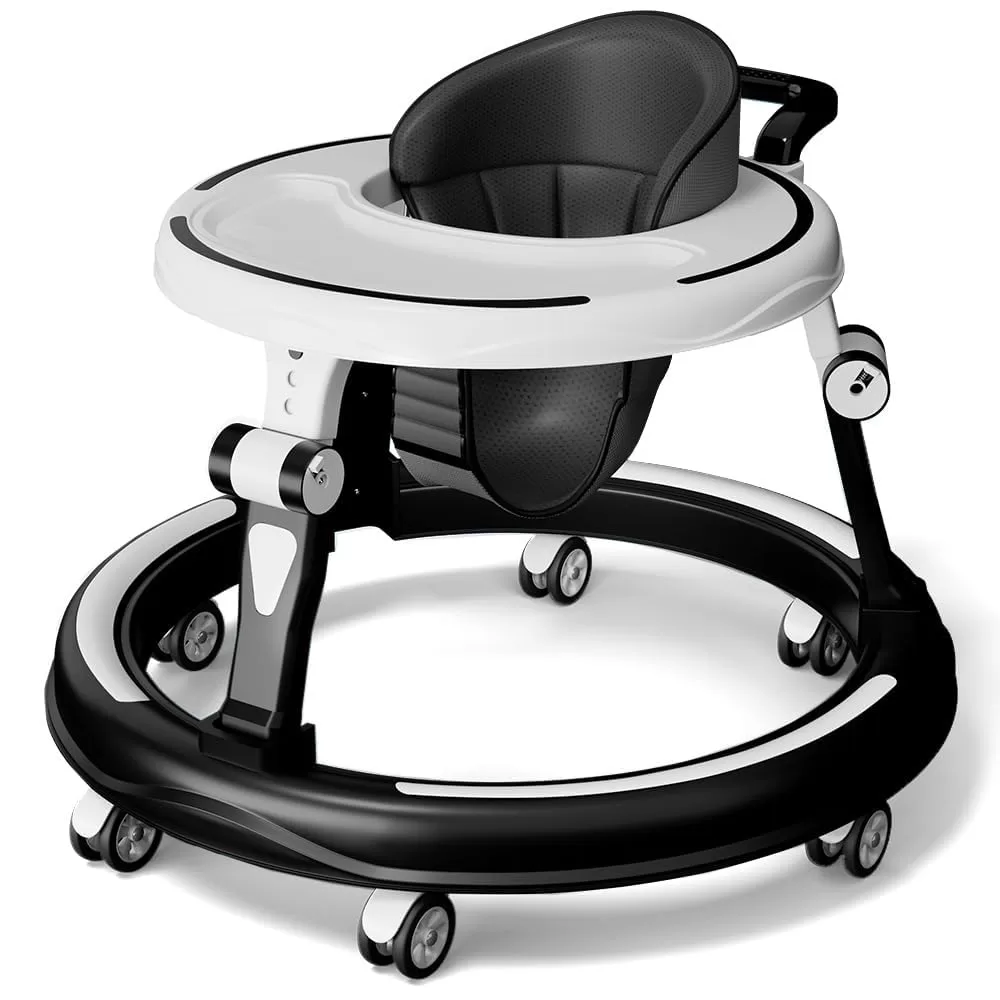
1. StarAndDaisy 360° Foldable Baby Walker (Black)
Features
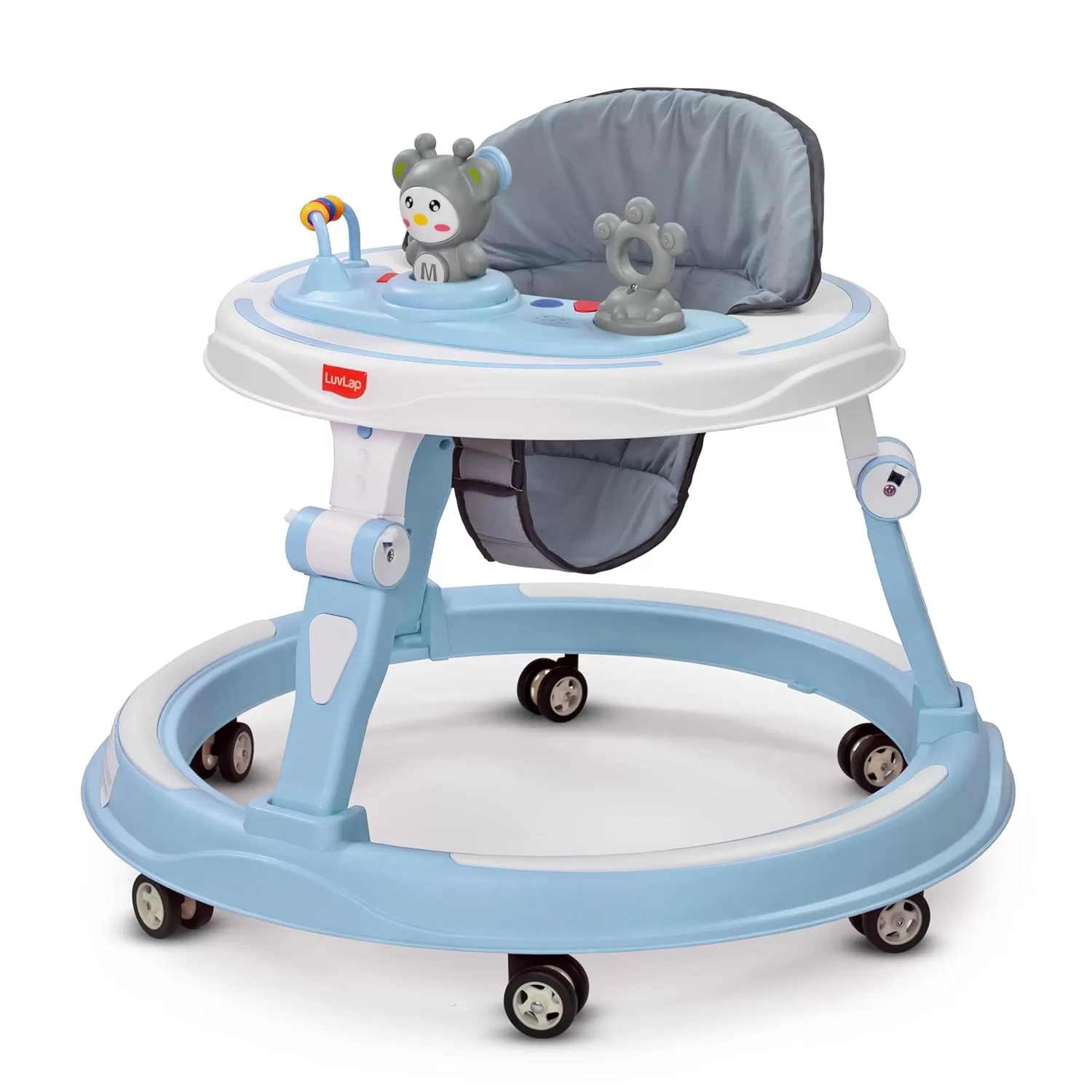
2. LuvLap 360° Joy Baby Walker
Features
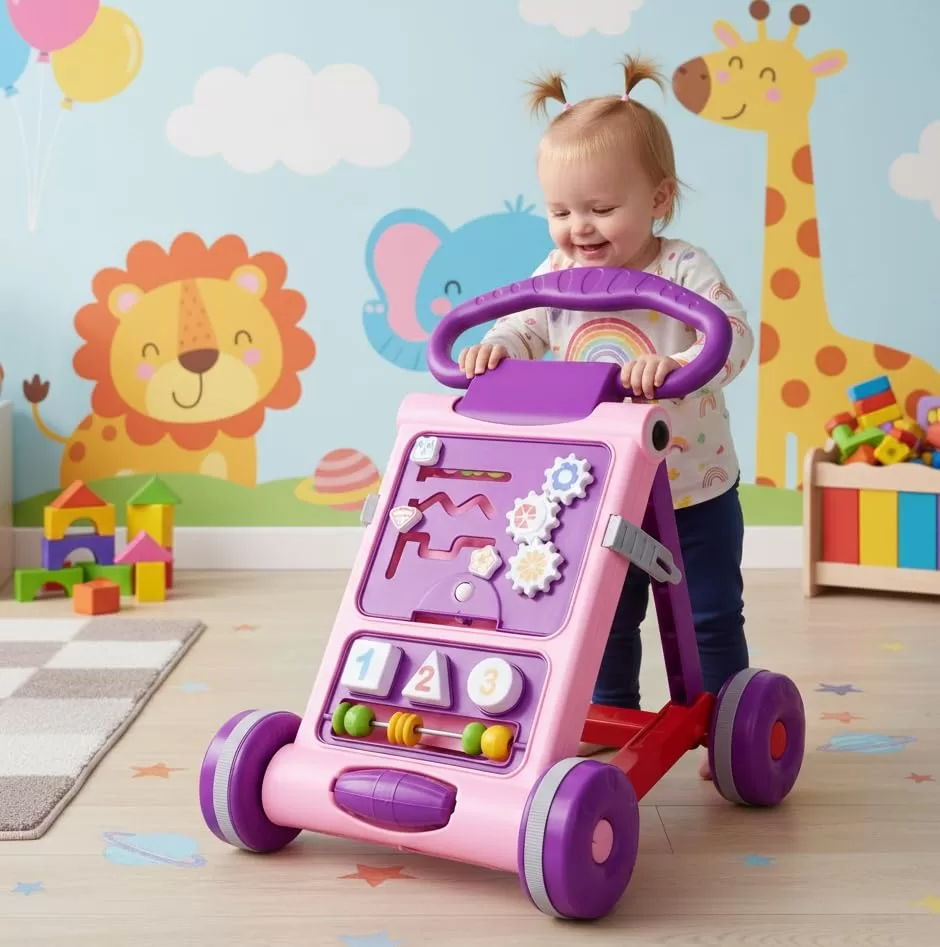
3. Goyal’s Baby Activity Push Walker
Features
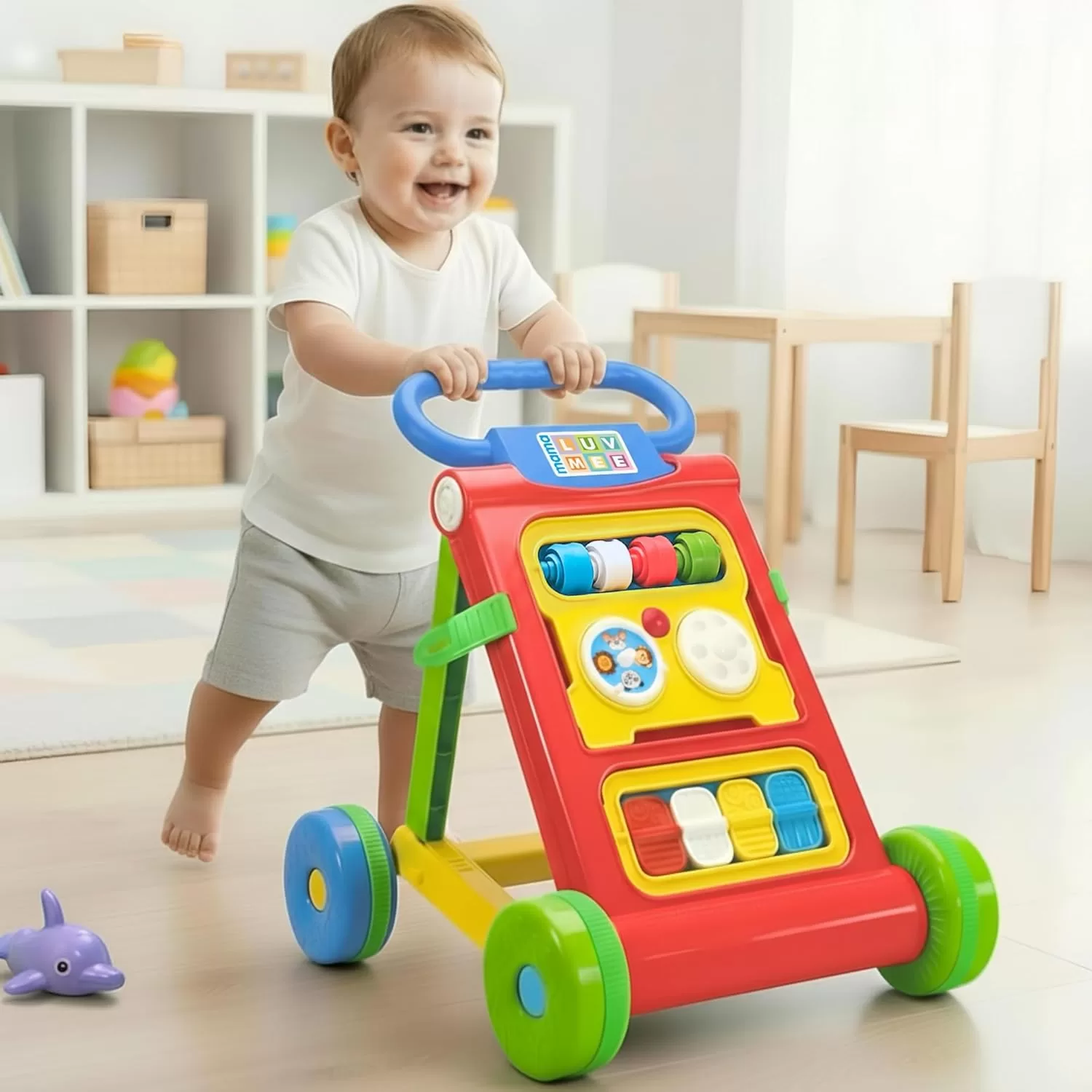
4. Mama Luv Mee Foldable Push Walker
Features
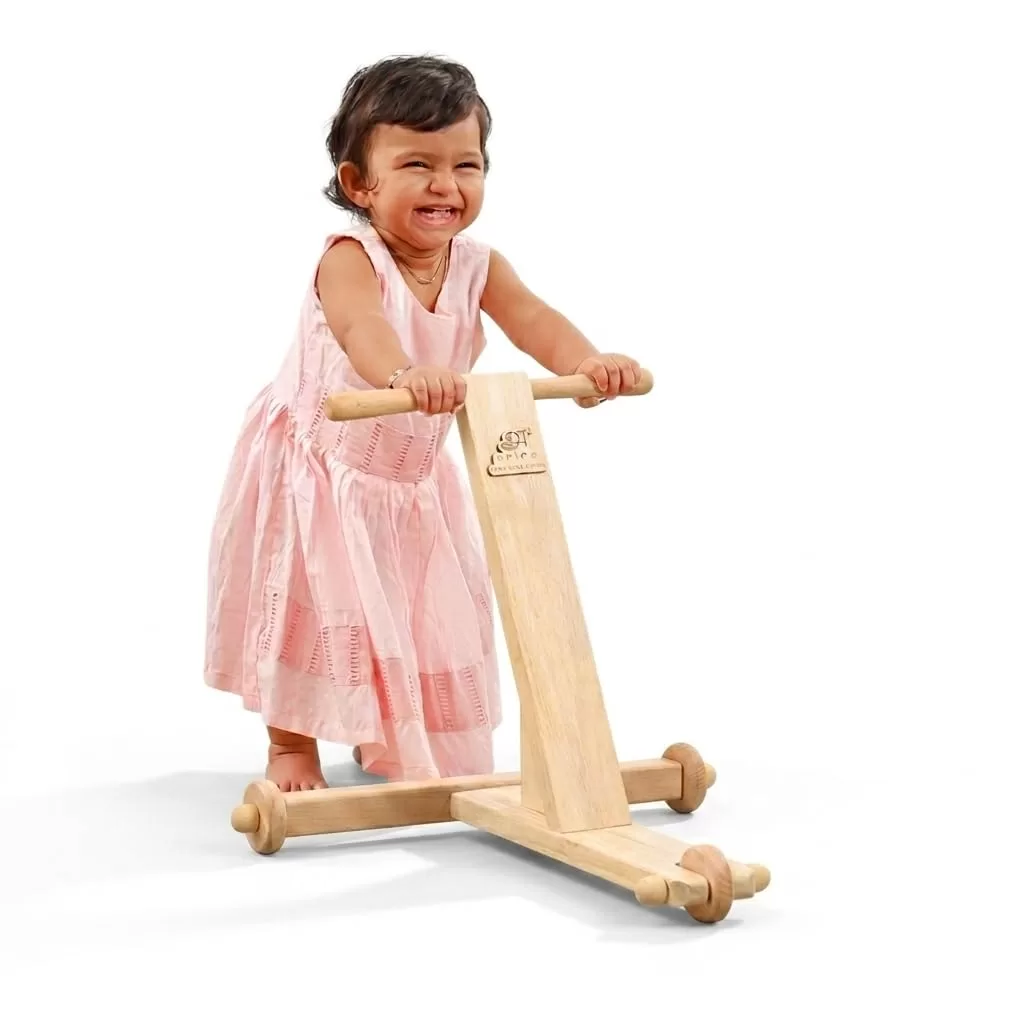
5. Ariro Toys Wooden Push Walker (Nadai Vandi)
Features
Side-by-side snapshot: how the 5 baby walkers compare
If you are short on time, here is the quick comparison across the 5 walkers in this guide. Use this as a first cut, then read the individual product write-ups above for the full nuance.
| Walker | Type | Age range | Price band | Best for |
|---|---|---|---|---|
| StarAndDaisy 360° Foldable | Sit-in 360° | 6-24 months | ~₹1,200 | Compact flats, most-popular budget pick, foldable storage |
| LuvLap 360° Joy | Sit-in 360° | 9+ months | ~₹1,600 | Established Indian brand, switchable food and musical tray |
| Goyal’s Activity Push Walker | Push walker | 6-15 months | ~₹1,000 | Highest-volume budget push walker, AAP-aligned format |
| Mama Luv Mee Foldable Push Walker | Push walker (foldable) | 6-18 months | ~₹900 | Smallest flats, foldable push-handle design |
| Ariro Toys Wooden Nadai Vandi | Wooden Montessori push walker | 9+ months | ~₹2,400 | Heritage build, plastic-free, multi-baby longevity |
The pattern that emerges from the table is clear. The two sit-in 360° walkers serve the contained-time-for-busy-parent use case at a budget under ₹1,800. The two plastic push walkers serve the active-walking-development use case at an even lower price band. The wooden nadai vandi sits in its own category as a heritage-grade purchase that lasts longer and looks like furniture. Most Indian families end up buying one walker for a 12 month window. A few buy two in sequence, starting with a sit-in and graduating to a push walker.
Why Indian parents are reaching for a baby walker around the 7 month mark
Most parents I know start the baby-walker conversation around the time their baby starts pulling up to stand. That is usually 7 to 9 months for sit-in walkers and 9 to 12 months for push walkers. There is a real moment in early infancy where your baby is too big to be content in a playmat and not yet stable enough to walk on their own. That gap is exactly where a walker fits.

The honest answer to why baby walkers stay popular in India is convenience. Most Indian flats are compact. Most Indian families do not have a dedicated nursery. Cooking, cleaning, and watching the baby happen in overlapping rooms, often at the same time. A walker that holds the baby securely, gives them a 360° view, and offers a tray of toys is a practical extension of the parent’s hands. It is not a replacement for floor play, and the better walkers are designed to be used in 15 to 20 minute bursts rather than as an all-day seat.
There is also a developmental angle. A baby with a stable view of the room learns to track movement, recognise faces from a distance, and reach for objects with intent. Sit-in walkers extend this curiosity by giving the baby the freedom to roll towards what they want. Push walkers go a step further by training the leg and core muscles a baby will use to walk independently. Neither format is magic. Both are tools that work when used in moderation alongside floor time, tummy time, and supervised crawling.
Where the conversation gets complicated is around safety. The American Academy of Pediatrics has long advised against sit-in baby walkers because of the speed they give pre-walking babies near stairs. Push walkers and stationary activity centres are usually the recommended alternative. In Indian homes the calculus is slightly different because most flats are single-level, fewer homes have stairs inside the unit, and the safety concern shifts to thresholds, kitchen entries, and balcony doorways. The risk is real, but it is more manageable than the headline suggests if you set up the room sensibly.
How to choose the right baby walker for your home
The walker you ultimately want is the one that fits three things: your baby’s developmental stage, the floor and layout of your home, and the realistic amount of supervision you can offer. Most buyers focus only on price and toys, which is exactly how a walker ends up unused after the first month. Here is the framework I use when comparing options.
Match the format to your baby’s stage
The single most important question is how stable your baby is right now. A baby who can sit unsupported for several minutes and hold their head completely steady is ready for a sit-in walker. A baby who is already pulling up to stand against the sofa, taking unsteady steps with hand support, or trying to push themselves up from crawling is ready for a push walker. If your baby is between these stages, a sit-in walker for short sessions is fine, but be ready to switch to a push walker within 6 to 8 weeks. Trying to keep a confident pre-walker in a sit-in walker is when babies get frustrated and parents wonder why they bought the thing.
Look at the safety basics first, the toys second
Every reputable baby walker in India should have a wide stance base, a sturdy frame, and either anti-rollover wheels or a wheel layout that makes tip-over unlikely. Adjustable height in 2 to 3 stages matters more than parents realise because babies grow fast and a walker at the wrong height pushes them onto their toes. The seat cushion should be removable and washable. The toy tray should clip on and off. Look for products that meet or reference the Bureau of Indian Standards safety standards, which is the Indian regulatory authority for product safety.
Toys are the secondary feature, not the main one. A walker with a flashy musical tray that is poorly built is a worse walker than a quieter one with a wider, sturdier base. If the toys can be removed for cleaning that is a plus, especially during teething when everything goes in the mouth.
Audit your floor before you buy
Indian floors are not American floors. Most Indian homes are tile, marble, vitrified, or polished cement. These are smooth, fast surfaces. Plastic wheels skid easily on tile, especially in kitchens and bathrooms where there might be a small water film. Look for walkers with rubber-tread wheels or non-slip wheel covers. If your home has thresholds between rooms, those small step-ups between the kitchen and the living room, the walker should not be used to cross them. A baby in a sit-in walker hitting a 1 to 2 inch threshold at speed can tip forward.
Match the walker to the size of your home
If you live in a 1BHK or a 2BHK in a Tier 1 or Tier 2 city, storage matters. A walker that does not fold takes up the kitchen entry. Foldable walkers like the StarAndDaisy 360° and the Mama Luv Mee push walker collapse for behind-the-sofa or under-the-bed storage. Wooden push walkers like the Ariro nadai vandi do not fold, but they look like furniture and tend to live in a corner without feeling out of place. Plastic walkers that do not fold are usually the worst storage outcome in a small flat.
Decide what you actually want from it
If you want a walker that gives you 20 minutes of safe contained baby time so you can finish cooking, a sit-in 360° walker is honestly the most pragmatic pick. If you want a walker that helps your baby actually learn to walk independently, a push walker is the right tool. If you want both, buy them in sequence rather than at once. The sit-in walker covers 7 to 12 months and the push walker covers 10 to 18 months. Or pick a single push walker and accept that the contained-time argument goes to your playpen instead.
Set a sensible budget
Baby walkers in India cost between roughly ₹800 and ₹4,500 depending on type. Most plastic sit-in 360° walkers and basic push walkers sit in the ₹900 to ₹1,800 band, which is where the StarAndDaisy 360°, the LuvLap 360° Joy, and the Goyal’s push walker land. Wooden Montessori push walkers like the Ariro nadai vandi sit in the ₹2,000 to ₹2,500 band because the materials and construction are different. Spending more than ₹3,000 on a walker is usually only justified if you want the heritage wooden format or a premium imported brand. Walkers are not a use-for-a-decade purchase. The window of use is roughly 6 to 18 months. Spend accordingly.
Baby walker sizes and variants in India: a quick reference
Indian listings use a range of overlapping size and age descriptors. Here is the cleanest way to read them.
- 6 to 12 months: This is the entry-level age band, almost always for sit-in 360° walkers. The seat is at the lowest setting, the baby’s feet just touch the floor, and the walker’s main job is contained mobility, not real walking practice.
- 9 to 18 months: The active walker age. Most sit-in walkers raise to a higher setting now. Push walkers are typically targeted at this band because the baby has the leg strength to push from behind.
- 12 to 24 months: The transition-out window. By this stage your baby is walking independently and the walker becomes more of a toy with wheels than a developmental tool. Most parents retire the walker by 18 months.
- Sit-in 360° walker: A seat surrounded by a wheeled frame. The baby sits inside, feet touch the floor, and they roll the unit around using their legs. Examples in this guide: StarAndDaisy 360° and LuvLap 360° Joy.
- Push walker (also called activity walker or learning walker): A wheeled cart with a handle the baby pushes from behind. The baby is standing while pushing. Examples in this guide: Goyal’s, Mama Luv Mee, and the Ariro wooden nadai vandi.
- Foldable: The frame collapses for storage. Almost mandatory in small Indian flats.
- Adjustable height: Usually 2 or 3 settings. Lets the walker grow with the baby across the 6 to 18 month window. Without this, the walker fits properly for only a couple of months.
- Anti-rollover wheels: Front wheel guards that catch the lip of a step or threshold and prevent forward tipping. A real safety feature, not just a marketing claim, but only on smaller drops.
- Activity tray vs musical tray: Activity trays have shape sorters and tactile elements. Musical trays add buttons, lights, and sounds. The musical type is more entertaining for the first month and more annoying for the next twelve.
Baby walker vs door bouncers, jumpers, and stationary activity centres
Walkers are not the only way to give your baby contained mobility. Three other formats compete for the same parental attention, and the right choice depends on your baby’s stage and your room.
Walker vs door bouncer
A door bouncer is a fabric seat suspended from a doorway clamp that lets the baby bounce in place. It is a smaller, lighter, more portable alternative to a sit-in walker, and it does not roll. I covered this format in detail in our best door bouncer in India guide. The short version is that door bouncers are best for the 4 to 9 month range and shorter sessions of 10 to 15 minutes. They build leg strength without giving the baby the speed a walker does. If your baby is too young for a walker but too restless for a playmat, a door bouncer fills the gap. Many Indian families end up using a bouncer for a few months and then graduating to a push walker, skipping the sit-in walker entirely.
Walker vs baby jumper
Baby jumpers are stationary frames with a suspended seat. The baby bounces in place but the unit does not move across the floor. Jumpers offer most of the leg-development benefit of a sit-in walker without the speed risk. The trade-off is footprint. A jumper takes up about a square metre of floor and does not fold easily. Most Indian flats lack the dedicated space for a permanent jumper, which is why door bouncers and walkers tend to win in this country.
Walker vs stationary activity centre
A stationary activity centre is a 360° seat with toys around it that does not have wheels. It is the safest of the four options because the baby cannot move at speed. It is also the most boring once the baby has spent a week with the same toy bar. If your home has stairs inside the unit, or if your baby is below 7 months and you want a contained option for short sessions, an activity centre is the safer pick. If your baby is older, more mobile, and more curious, a walker or push walker will hold their attention longer.
Where to buy a baby walker in India
Amazon India, Flipkart, FirstCry, and the larger baby retail chains all carry baby walkers. The five products in this guide all link to Amazon India because that is where the inventory is widest and the verified-review trail is most reliable. But the same products often appear on Flipkart and FirstCry, sometimes at slightly different price points. Here is how to vet a listing before you click buy.
- Verified ratings only: Look at the rating and review count together. A walker with 4.6 stars and 12 reviews is statistical noise. A walker with 3.9 stars and 3,000 reviews is real signal. The Goyal’s push walker in this guide has 3,900+ reviews, which is genuine social proof for the budget push-walker segment.
- Read the 3-star reviews: 5-star and 1-star reviews are usually emotional. The 3-star reviews are where you find honest tradeoffs from real users.
- Check the seller, not just the brand: On Amazon India, prefer listings sold and shipped by Amazon, or by the brand’s official store. Third-party sellers on plastic baby goods are where counterfeits sometimes appear, especially around the LuvLap and Fisher-Price brands.
- Confirm the age range matches: Some listings claim the walker fits 6 to 24 months. Cross-check the seat-height adjustment range against your baby’s measurements. A walker that only adjusts in two settings will not actually serve a 6-month-old and a 22-month-old well.
- Read the return policy: Walkers are bulky returns. Make sure the seller has a clear return window in case the unit arrives damaged or does not fit your home as expected.
- Avoid grey-market imports: Some listings show foreign-made walkers without a BIS reference. Stick to listings that name the manufacturer and have an India warranty number you can call.
How to use a baby walker for the first time
The first session with a new walker tells you almost everything about whether the walker will get used. Get the setup right and your baby will lean into it. Get it wrong and the walker becomes the corner-of-the-room dust collector everyone warns about.
Set up the room before you set up the baby
Move the rugs, runners, and trailing electrical cords out of the room. Close the kitchen door if you have one. Block off any thresholds with a rolled towel. Push furniture away from the path the walker will roll. If you have stairs inside the flat, gate them off completely before the walker comes out. The walker rolls faster than you think, and a baby in a sit-in walker can cover several metres in 3 seconds. Most walker injuries in India happen in the first two weeks of use because the parent has not yet recalibrated to the new speed.
Set the seat height correctly
The baby’s feet should be flat on the floor when seated, not on tiptoes. If the baby is on tiptoes, the walker is too high. Drop it one level. If the baby’s knees are bent at sharp angles, the walker is too low. Raise it one level. Tiptoe seating is the single biggest reason sit-in walkers get blamed for delaying walking. It teaches the baby to push off the toes instead of the full foot. Adjust the height the moment your baby looks uncomfortable.
Start with a 10 minute session, supervised
Do not put the baby in for an hour on day one. Start with 10 minutes, with you in the same room and watching. Most babies are surprised by the freedom and will spend the first couple of minutes simply rotating in place before they figure out how to roll forward. Watch how they react to the toy tray, how they engage their legs, and how they manage transitions across surfaces. If your baby cries within the first 5 minutes, take them out. They are not ready, or the seat is uncomfortable, or both.
Build up to 20 minutes, twice a day
Once the baby is comfortable, the working window is 15 to 20 minutes per session and 30 to 40 minutes total per day. More than that and you are using the walker as a babysitter, which is not what it is designed for. Two short sessions, one in the morning and one in the late afternoon, is the sweet spot for most babies in this age range. If your baby is using a push walker, the 20 minute cap matters less because the baby controls how long they engage. They will simply abandon the walker when they are tired.
Pair the walker with floor time, not against it
Walkers complement floor play. They do not replace it. Most pediatric guidance recommends 30 to 45 minutes of supervised floor time per day for babies in the 6 to 12 month range. If your baby is in the walker for 30 minutes, make sure they are also crawling, doing tummy time, or playing on a mat for at least an equal amount. The walker is one of several mobility tools, not the primary one.
Avoid using the walker after dinner or close to bedtime
A walker session right before bedtime is a common Indian-parent mistake. The combination of bright tray lights, musical buttons, and the rush of new mobility wakes the baby up rather than tiring them down. Most babies need a calm 30 to 45 minute pre-bed window with low light, no screens, and quiet floor play. Save the walker for the morning, the late afternoon, or the early-evening dinner-prep window when you genuinely need contained baby time. By 7 to 8 PM the walker should be folded and put away.
Care, cleaning, and when to replace your baby walker
Baby walkers in Indian homes face conditions most product manuals do not cover. Humid summers, monsoon storage, marble floors that scratch wheels, and food spills from a tray that doubles as the breakfast table. A bit of care at the right moments extends the walker’s life from 6 months to the full 12 to 18 month window.
After every meal-tray session, wipe the tray with a mild soap solution and a soft cloth. Once a week, unclip the seat cover and machine wash on a gentle cycle, then air dry rather than tumble dry. Once a month, inspect the wheel housings for trapped hair, food crumbs, or rug fibres. Use a dry toothbrush to clear them before they jam the wheel rotation. Tighten any loose screws on the frame. Plastic walkers loosen up after a few weeks of vigorous use.
For wooden push walkers like the Ariro nadai vandi, cleaning is gentler. Avoid soaking the wood. A damp cloth followed by a dry buff is enough. If the wood gets sticky from spills, a tiny amount of food-grade mineral oil rubbed in along the grain restores the finish without leaving a residue your baby might lick.
The four signs your walker is ready for retirement are: wheels that no longer roll smoothly even after cleaning, frame joints that wobble even after tightening, a seat cover that has been washed so many times it is fraying at the leg holes, and a baby who has clearly outgrown the largest height setting. Any of these and the walker has had a good run. Most Indian families pass the walker on to a relative or sell it on a community group, since structural plastic walkers can serve two babies if maintained well.
If your walker came with a removable activity tray, remember to keep the tray itself for use as a high-chair attachment or a separate floor toy after the wheeled portion retires. This is the cheapest way to extend the value of a walker purchase by another 12 months.
Monsoon storage: the one Indian-specific care detail no manual covers
Indian monsoons do real damage to baby walkers stored in unventilated corners. If you live in Mumbai, Goa, Kerala, the Konkan, or any of the high-humidity coastal belts, do not store the walker in a closed cupboard during July, August, or September. The combination of dust, humidity, and trapped pockets of food residue is what turns a 6 month walker into a moldy 9 month one. The fix is simple. Keep the walker in a ventilated corner of the living room or behind the sofa, not in a sealed loft or cupboard. Wipe it down once a week. Run a fan past it for 10 minutes after every cleaning. Wooden push walkers like the Ariro nadai vandi need the same treatment, plus a thin coat of food-grade mineral oil at the start and end of monsoon season to keep the wood from drying out or absorbing too much moisture.
Baby walker safety: the warning signs every Indian parent should know
Walkers have a long history of being either over-recommended or over-feared. The truth is in the middle. A walker used in a thoughtful setup with active supervision is a manageable tool. A walker treated as a hands-off babysitter is the format that lands in pediatric warning lists. Here are the practical safety signals every parent should watch for in the first weeks of use.
- Tipping forward: If your baby’s walker tips forward when crossing thresholds, the wheels are too small or the front anti-rollover guards are missing. Stop using the walker on uneven surfaces. Switch rooms or move to a push walker.
- Skidding sideways: On marble or glossy tile, plastic wheels can skid sideways when the baby pushes off. If you see this, the wheel material is wrong for your floor. Either swap wheels (some walkers ship with replacement rubber wheels) or move the walker to a carpeted room.
- Baby on tiptoes: If the baby is permanently on their toes, the seat is too high. Drop it one setting. Persistent tiptoe seating is the single risk factor most associated with delayed independent walking.
- Baby slumping or leaning: A baby who is leaning forward or slumping to one side has not yet developed the trunk control to be in a walker. Take them out. Try again in 4 to 6 weeks.
- Speed across the room: A baby in a sit-in walker can cross 3 to 4 metres in less than 5 seconds. If your room layout allows that kind of clear run, you do not have time to react if something goes wrong. Add furniture barriers, rugs that slow the wheels, or simply use the walker in a smaller room.
- Unsupervised use near water: Never place a walker near a bathroom door, the kitchen sink, or any room with a bucket of water. The walker’s speed and the baby’s centre of gravity make this category of accident the most dangerous.
- Stuck wheels: If wheels stick when the baby pushes off, the baby will lurch forward unexpectedly. Check the wheels weekly.
- Cracked plastic: A hairline crack in the seat housing or the frame can fail without warning. Inspect the walker for cracks every two weeks. If you see one, retire the walker immediately.
If you are setting up a walker for the first time and you also use a door bouncer guide, remember the safety conventions are different. Walkers need clear floor space and threshold management. Bouncers need a sturdy doorway frame and a soft landing zone underneath. Do not assume that one product’s safe-zone setup transfers to the other.
Common baby walker mistakes Indian parents make and how to avoid them
Most walker problems trace back to a small set of repeated mistakes. None of them are catastrophic on their own, but together they explain why some families end up disappointed with the walker and others swear by it. Run through this list before your first session.
- Buying a walker before the baby is ready: A 5 month old does not need a walker. The baby will simply slump in the seat, the walker will sit unused, and you will have spent ₹1,500 on a 6 month future-purchase. Wait until the baby is sitting unsupported for several minutes.
- Using the walker as a babysitter: 30 minutes of contained time is fine. 3 hours is not. The longer the baby is in the walker, the more posture issues, leg-fatigue issues, and frustration-related crying you will deal with later.
- Skipping the height adjustment as the baby grows: The baby grows about 1 cm a month between 6 and 12 months. A walker height that fit perfectly at 7 months will have the baby on tiptoes by 9 months. Re-check the height every 4 to 6 weeks.
- Letting the walker into the kitchen: Kitchens have heat, sharp corners, water on the floor, and electrical sockets at baby height. A walker should never enter a kitchen, even briefly. Use a baby gate at the kitchen entry from day one.
- Buying the cheapest possible walker: Walkers in the ₹500 to ₹800 band tend to have brittle plastic, narrow stance bases, and skid-prone wheels. The ₹900 to ₹1,800 band is where the safety basics finally show up. There is no real reason to go below ₹900 on a walker.
- Ignoring the recall and warranty trail: Reputable Indian brands like LuvLap publish warranty terms and have working customer service. House-brand and white-label walkers often do not. If something fails on a no-name walker you have no recourse. Stick to brands with a real India presence.
- Treating the walker as the answer to delayed walking: A walker does not teach a baby to walk. The baby’s nervous system, leg strength, and confidence teach the baby to walk. The walker is a tool that can either help or hinder, depending on how it is used.
Final thoughts: picking the best baby walker for your specific situation
If you are a first-time parent in a small Indian flat with smooth tile floors, a baby aged 7 to 10 months, and you mostly want 20 minutes of contained baby time during dinner prep, the StarAndDaisy 360° Foldable Baby Walker is the most pragmatic pick. It folds, it adjusts, and 2,500+ Amazon India ratings cannot be wrong about its everyday usability.
If brand reputation matters to you and you want a walker from one of India’s most established baby-care companies, the LuvLap 360° Joy Baby Walker is worth the small premium. The switchable food and musical tray is a genuine quality-of-life feature, and LuvLap’s after-sales presence in India is more reliable than most house brands.
If you are leaning towards the AAP-aligned push-walker format and you want the highest-volume budget option, the Goyal’s Baby Activity Push Walker has 3,900+ ratings for a reason. It is light, lasts the typical 9 to 15 month window, and does the one job a push walker is supposed to do.
If you have a smaller flat and need a push walker that folds away when not in use, the Mama Luv Mee Foldable Push Walker solves the storage problem without sacrificing the push-handle format.
And if you are a Montessori-leaning family, you want a wooden walker that doubles as a piece of furniture, and you are willing to pay a small premium for build quality and aesthetics, the Ariro Toys Wooden Push Walker (Nadai Vandi) is the heritage pick. It will outlast every plastic walker on this list and will probably end up being passed down to a sibling or cousin.
Whichever walker you choose, the rules above stay the same. Set up the room. Match the format to your baby’s stage. Cap session time. Pair with floor play. The walker is a tool, not the main event. Used right, the right walker buys you and your baby a meaningful chunk of mobility, curiosity, and contained calm during the busiest months of early infancy.
Frequently Asked Questions
What is the right age to start a baby on a walker in India?
Most baby walkers sold in India list 6 months as the minimum age, but the more reliable cue is your baby’s neck and back control. Wait until your baby can sit unsupported for several minutes and hold their head steady. For sit-in 360° walkers that is usually around 7 to 9 months, and for push walkers it is usually 9 to 12 months when your baby is already pulling up to stand. Starting too early is the single biggest mistake parents make.
Push walker or sit-in 360° walker: which is better for my baby?
Push walkers are the format most pediatric bodies recommend because the baby pushes the walker themselves and uses real walking muscles. Sit-in 360° walkers are more popular in India because they keep the baby contained and busy, but they let babies walk on their toes which some experts believe can delay independent walking. If your baby is already pulling up to stand, choose a push walker. If your baby is younger and still working on sitting, a sit-in walker with very supervised use of 15 to 20 minutes at a time is the more honest middle ground.
How long can a baby be in a walker each day?
Cap walker time at around 15 to 20 minutes per session and 30 to 40 minutes total per day. Two short sessions are better than one long one. The reason is twofold. First, walkers strain hip and ankle posture if used for hours. Second, a walker is not a babysitter and unsupervised time is when the bumps and falls happen. Most pediatricians prefer floor time, supervised crawling, and tummy time as the main movement diet.
Are baby walkers banned in India?
No, baby walkers are not banned in India. They are sold legally on Amazon India, Flipkart, FirstCry and at most baby stores. Some countries like Canada have banned the sit-in style for safety reasons, but India follows Bureau of Indian Standards rules instead and the sit-in style is still common. The bigger picture: legal does not mean recommended. Most pediatricians prefer push walkers or activity centres over sit-in walkers.
Can a baby walker delay walking?
Sit-in walkers can mildly delay independent walking in some babies. The reason is that they let the baby move forward by pushing on their toes and pelvic floor instead of building the leg-extension and balance muscles real walking needs. Studies suggest the delay is usually a few weeks rather than months, and it disappears once the walker is retired. Push walkers, where the baby has to support their own weight to push, do not have this issue.
Are baby walkers safe on tile or marble floors?
Yes, but with two adjustments. First, choose a walker with rubber-tread wheels rather than hard plastic, since rubber grips smoother surfaces. Second, never use the walker near steps, ramps, or thresholds between rooms. Marble and tile are extremely fast surfaces, and a walker that crosses a 2 inch threshold on speed can tip. Use the walker only in single-level rooms with no doorway risers.
How do I clean a baby walker between uses?
Wipe the plastic frame and tray with a mild soap solution and a soft cloth after every use, especially before mealtimes. Unclip the seat cover once a week and machine wash on a gentle cycle. Inspect the wheels monthly for stuck hair or food, and tighten any loose screws on the frame. For wooden push walkers like the Ariro nadai vandi, avoid soaking the wood and use a damp cloth followed by a dry buff.
Related reads:
We’re building out our baby gear coverage. Expect dedicated guides on baby playmats, baby jumpers, and indoor playpens soon.
